The Little Known Theme of Yom Kippur and an Opportunity You Should Really Consider

Having trouble viewing this email? View it online

 
Yom Kippur • 10 Tishrei •  September 29-30
 
Candle Lighting: 6:35pm | Fast Begins: 6:53pm
Fast Ends on September 30 at 7:28pm

See below for services schedule | Open to the entire Jewish Community

Message from Rabbi Greenberg

The Little Known Theme of Yom Kippur and an Opportunity You Should Really Consider

Yom Kippur is widely known as the holiest and most solemn day of the year, since it is the Day of Atonement, commemorating the first time G-d granted the Jewish people atonement for the terrible sin of the Golden Calf. We are therefore commanded to refrain from all physical pleasures such as eating, drinking, washing our bodies and wearing leather shoes and to spend the day in prayer, confession and reflection.

Another important event occurred on that first Yom Kippur when Moses procured clemency for the Jewish people.

Let me begin with a brief overview of the events leading up to Yom Kippur. The revelation at Sinai occurred 50 days after the exodus from Egypt and the Ten Commandments were communicated to them as a nation. Moses remained on the mountain for 40 days and nights to learn the entire Torah from the A-lmighty, after which he received the two tablets engraved with the Ten Commandments – representing the Torah, known today as the Five Books of Moses.

Toward the end of this period, a tragic mistake occurred and the Jews served the Golden Calf. Upon witnessing this travesty after descending the mountain, Moses smashed the two tablets in a successful attempt to save the Israelites from certain annihilation at the Hand of G-d. The nation was ashamed of their misjudgment and Moses ascended Mt. Sinai to intercede on their behalf for 40 days and nights.

G-d instructed Moses to prepare a second set of tablets to replace the first ones and to ascend the mountain once again. 40 days later, G-d granted the Jewish people atonement for their treacherous sin and Moses descended the mountain with the second set of tablets.

Our sages teach us that the Ten Commandments engraved on the second set represented the entirety of Torah scholarship for all eternity. On Yom Kippur we were granted the Torah in a greater measure than before!

This brings me to an amazing opportunity you can capitalize on this Yom Kippur.

The famous Jewish sage Maimonides authored a digest of all the 613 mitzvoth called Sefer Hamitzvot. In 1984, the Rebbe introduced a novel study cycle of Maimonides’ great work on Jewish law and incorporated and easy to follow system of learning all 613 mitzvoth in under a year. Several days ago, the 36th was completed and the new cycle is well under way.

On Sunday, the day after Yom Kippur we start studying the first mitzvah. Commit a few minutes a day and by Rosh Hashanah you will have studied about all 613 mitzvoth!

There are many resources available in numerous languages. Easy-to-read overviews, audio and video classes and a daily email straight to your inbox. There is even an app for it!Click here to find the best way for you to join.

This is a great way to bring the inspiration of Yom Kippur to the rest of the year. You will be happy you did it!

Best wishes for Gmar Chasima Tova – to be sealed for a good and sweet new year!

Good Shabbos and Good Yom Yov,

Rabbi Levi Greenberg
Synagogue Schedule
Shabbat and Yom Kippur

Friday Evening:
Kol Nidrei and Evening Services - 6:30pm

Shabbat Day:
Shacharit - 9:00am
Childrens' Service - 11:00am
Yizkor memorial Service - 11:30am
Mincha - 5:00pm
Neilah - 6:00pm
Holiday Ends at 7:28pm | Followed by a lavish Break of the Fast

Weekday

Shacharit
Sunday: 9:00am ● Monday & Thursday: 7:00am

Mincha & Maariv
Sunday - Thursday: 6:45pm

 
Latest Photos
Coming Up Soon!

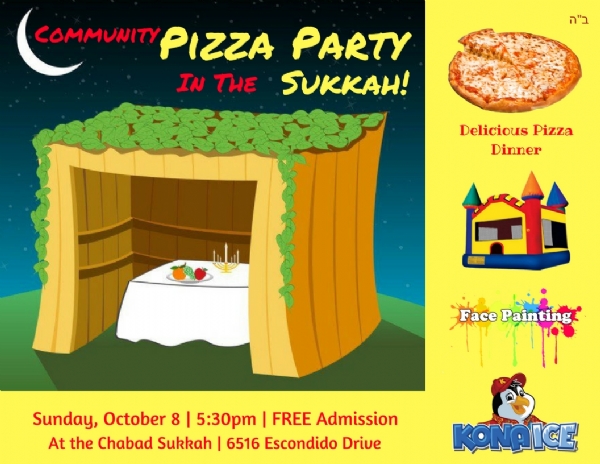
Sukkah Pizza Party 2017.jpg

Sukkah Lunch for seniors.jpg    

This week @ www.ChabadElPaso.com
This Week @ www.ChabadElPaso.com
  
Yom Kippur Info
19 Yom Kippur Facts Every Jew Should Know
Yom Kippur is the Day of Atonement, when we are closest to G‑d and most connected to the essence of our souls.
  
Video
The Rebbe’s Yizkor Speech
The unity of all Jews derives from the fact that every Jewish soul is “an actual part of G-d Above.” This not limited to Jews who are alive, but includes those who have passed on, as well.
  
Yom Kippur Reading
The Miraculous Sound of Disappearing Sin
We were just confirmed "sinless" moments prior. So, why do we now recite the blessing of Selach lanu, wherein we ask G‑d to "forgive us for we have sinned""?
  
Story
The Missing Wagons
Overcome by grief, the poor man barely managed to process the news before he passed out . . .
The Parshah In A Nutshell

The Sukkot and Shemini Atzeret Torah readings are from Leviticus 22-23, Numbers 29, and Deuteronomy 14-16. These readings detail the laws of the moadim or " appointed times" on the Jewish calendar for festive celebration of our bond with G-d; including the mitzvot of dwelling in the sukkah (branch-covered hut) and taking the " Four Kinds" on the festival of Sukkot; the offerings brought in the Holy Temple in Jerusalem on Sukkot, and the obligation to journey to the Holy Temple to "to see and be seen before the face of G-d" on the three annual pilgrimage festivals -- Passover, Shavuot and Sukkot.

On Simchat Torah ("Rejoicing of the Torah") we conclude, and begin anew, the annual Torah-reading cycle. First we read the Torah section of Vezot Haberachah, which recounts the blessings that Moses gave to each of the twelve tribes of Israel before his death. Echoing Jacob's blessings to his twelve sons five generations earlier, Moses assigns and empowers each tribe with its individual role within the community of Israel.

Vezot Haberachah then relates how Moses ascended Mount Nebo from whose summit he saw the Promised Land. "And Moses the servant of G-d died there in the Land of Moab by the mouth of G-d... and no man knows his burial place to this day." The Torah concludes by attesting that "There arose not a prophet since in Israel like Moses, whom G-d knew face to face... and in all the mighty hand and the great awesome things which Moses did before the eyes of all Israel."

Immediately after concluding the Torah, we begin it anew by reading the first chapter of Genesis (the beginning of next Shabbat's Torah reading) describing G-d's creation of the world in six days and His ceasing work on the seventh--which He sanctified and blessed as a day of rest.

 
Become a Partner

Stay In Touch!


This email is sent from Chabad Lubavitch. We'd love to stay in touch with you, but if you wish to be unsubscribed from this list please click here, or click here to manage your subscriptions. Sent via ChabadOne Communicator