Printed fromChabadElPaso.com
ב"ה

Rabbis' Blog

The Young Emissaries

 WhatsApp Image 2022-11-25 at 1.29.28 PM.jpeg

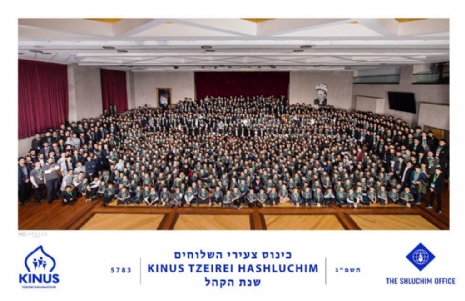
Last week Menachem and I traveled to New York for the annual conference of Chabad Lubavitch emissaries. Menachem joined the three-day overnight camp together with two thousand “young emissaries” from around the world, while I spent my time at workshops, celebrations, and networking with thousands of my colleagues.

It was a special weekend, with many memorable moments, but I’d like to share one episode that to me crystalized the entire conference and the global phenomenon of Chabad today. During the banquet held on Sunday evening, there was a video presentation highlighting seven emissaries representing seven decades of Chabad’s global work from the 1950s to the present.

Rabbi Berel Mochkin of Montreal Canada represented the pioneering emissaries of the 1950s and Rabbi Dovi Henig of Chengdu, China represented my generation of thirty-year-olds.

Upon arriving in Chengdu Rabbi Henig and his wife were “invited” to the local police station and “interviewed” separately. The communist authorities were curious to understand why the young couple moved there, and he patiently explained that they simply wished to service the ever-growing community of Jewish businesspeople and tourists with all their Jewish needs by setting up a synagogue and community infrastructure.

After a lengthy conversation, the officer pulled out a photo of the Rebbe from his desk drawer and asked “Who is this man to you?” Rabbi Henig had no patience to explain what exactly a Rebbe is and simply replied “He’s my father.”

The officer picked up the phone, dialed a number, conversed briefly in mandarin, and then asked “So Rabbi Freundlich (the Chabad emissary) in Beijing is your brother?”

The huge ballroom erupted in a thunderous laugh at the punchline, but it was a knowing and appreciative one. This was not a conference of colleagues with similar careers; it was a family reunion.

This week’s Parsha begins “And these are the generations of Isaac the son of Abraham; Abraham begot Isaac.” Our sages explain that with this repetitive sentence the Torah teaches us that not only was Isaac the biological son of Abraham, but he was also the spitting image of his father physically and spiritually, to the point that all who saw them immediately concurred that it was so. Despite their 100-year age gap, there was no generational gap between them at all.

The same is true about Chabad. Although the mission of our generation, to bring Judaism to every corner of the world, was launched by the Rebbe in 1950, its relevance, impact, and passion of the emissaries have not changed at all. The 80-year-old Rabbi Mochkin and 30-year-old Rabbi Henig shared the same stage as brothers with the same objective: to reflect the Rebbe’s love and dedication to every Jew wherever they may be.

That’s why Menachem’s three-day overnight camp is called “Conference of Young Emissaries” instead of “Children of Emissaries Conference,” because our mission transcends all ages and stages and is open to everyone who wishes to participate. Preparing the world for the era of true peace and kindness with the arrival of Moshiach.


Caring for everyone

Living Jewishly can become routine, especially in quiet times between holidays. However, although most days are identical to each other in scheduling and practice, Jewish life provides a dynamic change of scenery every single day of the year.

The Alter Rebbe, the founder of the Chabad movement in the 1770s, entered his study hall in a small Russian town and declared "We must live with the times" and returned to his study. His students were perplexed at the announcement as it seemed to contradict the very premise of the Chassidic lifestyle. To "live with the times" means following the ever-changing fashion trends and adopting the fluctuating morals dictated by society. Being a chossid means transcending all the nonsense and focusing on what is truly timeless.

It turned out the Rebbe was referring to the Torah portion (parsha) of the week. We complete the entire Torah each year by reading another portion during synagogue services on Shabbat. The portion is divided into seven parts called Aliyot and before and after each Aliyah someone else is honored to recite the blessing on the Torah.

The fact that the weekly parsha is divided into seven subsections is not only highly symbolic of Shabbat being the seventh day of the week. It makes the Torah portion relevant to the entire week, not just Shabbat. In fact, one of the ways to write the date on a letter or document in Torah culture is by writing “6th of Vayeira” which would mean “Friday of the week we read the parsha of Vayeira.”

This is what the Alter Rebbe meant about “living with the times.” On Sunday, the content of the first Aliya of the parsha we are scheduled to read the coming Shabbat is the Torah message we must live with on that day. On Monday the second Aliya and so on. In order to live with it one needs to learn it. That’s why it’s crucial to learn the daily Torah portion every single day.

On Sunday I studied in the beginning of this week’s parsha about Avraham’s golden standard of hospitality through which he shared the awareness of G-d with the entire world. He welcomed everyone into his tent and personally served them the best foods until they were nourished and satisfied and then inspired and sometimes cajoled them into thanking G-d for the food. He was a man with a divine mission that consumed his entire life.

On Monday the Torah describes how G-d decided to destroy the cities of Sodom and Gemorra due to their institutionalized moral depravity. They were greedy, stingy, deplorable, and ungrateful heathens; the polar opposites of Avraham. Nevertheless, he went out on a limb to argue with G-d not to destroy the cities. Without suggesting that he will assume responsibility for their moral rehabilitation Avraham declared that the presence of at least some good people in those cities should spare the rest. 

Although he was not successful, Avraham’s argument with G-d is profoundly meaningful. At great personal risk, he tried to help even those who were diametrically opposed to his ideals and way of life. Avraham inspires us today to learn to disagree with others while still respecting them as fellow human beings and caring for them as well.


When kids ask too many questions

My children ask many questions and as a parent, I try to answer to the best of my ability. Some answers I know off the cuff, while others can be found in books or on Google, and sometimes I need to think deeply before formulating a response. Their questions are typically motivated by their experiences and childish observations, and they are never inhibited by self-consciousness to refrain from asking “a stupid question.”

I am often enriched by searching for these answers, but the greatest gift of all is learning from them the value of wanting to know more and not taking things for granted. Why does “green light” mean “go” and “red light” mean “stop?” Why do some foods need to be cooked while others are eaten raw? I admit the incessant questions can irritate me sometimes, but I am reminded that Judaism exists only because a young child would not stop asking questions.

One of the earliest stories I recall from my childhood is about Abraham discovering G-d. At age three he realized a molten image that can be tossed around could not possibly be the creator of heaven and earth and, undeterred by his parents’ refusal to engage in the conversation, started searching for the most powerful force in the world.

Observing the sun hovering high above in the sky providing light and warmth for the entire world he determined it was the most powerful, but realized his mistake when the moon took its place at night. His honest and thorough investigation led him to discover that G-d is invisible, omnipotent, and omnipresent, contrary to the prevailing zeitgeist of idolatry. It was an evolving internal journey with major breakthroughs at age forty and forty-eight respectively until Abraham achieved the most profound divine consciousness available to man at the time.

G-d’s love for Abraham is unparalleled throughout the biblical narrative, and for good reason. But this relationship only happened, and the Jewish nation is here today because Abraham never stopped asking questions and searching for answers as a young child. He rejected the heathen worship of his elders and charted a new path for humanity by sharing his knowledge and faith with everyone in his time. The world is a more tolerant and peaceful place today because of an inquisitive three-year-old child.

We have much to learn from Abraham’s faith, sacrifice, kindness, and dedication, but the most empowering lesson of all is the importance of always learning and growing in our understanding of G-d. Unfortunately many are led to believe that asking questions about G-d is sacrilegious or a sign of rebellion. As long as we are searching for truth and not looking for excuses to shirk our responsibilities as Jews, learning more about G-d is the most Jewish thing we can do.

This Tuesday we start a new six-week course entitled My G-d: Defining the Divine. A fast-paced, fun and informative academic journey exploring the answers to 25 major questions about G-d and I invite you to join me on this theological adventure.

Click here to learn more about the course.

Click here to register.


Looking for older posts? See the sidebar for the Archive.