

This week world Jewry begins learning the second book of the Torah – Shemot. In various sources the entire book is called Sefer Hageulah – the Book of Redemption. While the first few parshiyot clearly serve as a historical record of the fascinating journey of our people from Egyptian bondage to freedom, the content of rest of the book does not seem to fit the title.
Upon further reflection we find that the content of the entire book is dealing with a far deeper and more consequential redemption than merely the liberation of a nation of slaves. It is the blueprint of the process through which the very nature of our world was transformed from a coarse and earthly reality to one that is worthy of reflecting and connecting to a greater and more sublime reality.
The book of Shemot can be divided into three categories, reflecting the three steps of this process.
- Redemption of the Hebrews from Egyptian bondage in a most miraculous way, destroying the great Egyptian empire (Shemot – Beshalach/Exodus 1-17).
- The revelation at Mt. Sinai and the giving of the Torah to the Jewish people through Moses (Yitro – Mishpatim/Exodus 18-24).
- Detailed instructions for the construction of the Tabernacle (Teruma – Pekudei/Exodus 25-40).
Redemption of Humanity: The ancient Egyptian Empire was the most depraved of all societies of the time. It was the epitome of self-centeredness and self-indulgence. Pharaoh proclaimed himself a deity and utterly rejected the notion of a higher purpose or power. This reflected the reality of humanity at the time. G-d destroyed this evil with the goal of educating the world that there is truly One Super Power and simultaneously redeemed the descendants of Jacob from this chronic disease forever. Now they were ready to engage in G-dly activity as a nation.
Redemption of the Physical: Today, we instinctively treat a Torah scroll with reverence. It is kept in a beautiful Holy Ark and rarely handled for any purpose other than to be read publicly during prayer services at synagogue. The Torah scroll is indeed holy. However, before the revelation at Sinai, such a phenomenon did not exist. Theoretically, if our patriarchs would write a Torah scroll, there would be no need to treat it with reverence. Physicality was not compatible to the G-dly reality and therefore could not contain and reflect G-dly energy in a revealed sense. It was bound to its earthiness. A Torah scroll was just a scroll.
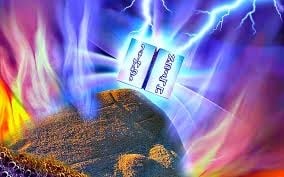
At Sinai the world changed forever. Now G-dly energy could permeate physical objects that are used for a mitzvah and they must be revered and cherished as befitting G-d Himself.
Redemption of the Mundane: As a prelude to the instructions for the construction of the Tabernacle G-d says to Moses (Exodus 25:8): They (the Israelites) should make a Sanctuary dedicated to Me and I will dwell in their midst. Our sages explain that this verse implies that through the Tabernacle, G-d dwells and is revealed in every aspect of life. The mundane routine of life can now reflect a higher purpose. G-d can be found in simple interactions, household chores and pleasurable hobbies as well. Surely we are all obligated to observe all the mitzvoth of the Torah; but more amazingly, we are capable of experiencing the divine beyond the walls of the synagogue – in our home, workplace and even the gym.
As Maimonides teaches (Mishnei Torah Deot 3:3): Thus, whoever walks in such a path all his days will be serving G-d constantly; even in the midst of his business dealings. . . Even when he sleeps. . . On this matter, our Sages have directed and said: "And all your deeds should be for the sake of Heaven." This is what Solomon declared in his wisdom: "Know Him in all your ways and He will straighten your paths"
We have been empowered to find meaning in every aspect of life. Everything we do, when done properly, becomes a vital component in making our world a better and more G-dly place.