

In preparing this message, I chose to open with an inspiring quote about optimism. Google yielded this gem from Winston Churchill:
A pessimist sees the difficulty in every opportunity; an optimist sees the opportunity in every difficulty.
♦
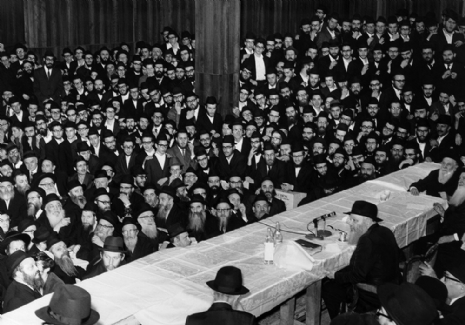
On the Shabbat morning of the 10th of Shevat, 1950, the Previous Rebbe passed away. Exactly one year later, the Rebbe assumed the mantle of leadership of the Chabad Lubavitch movement.
By divine providence, the Previous Rebbe had instructed that a Chassidic discourse entitled Basi Legani be published for that fateful Shabbat. The Rebbe considered it a spiritual guide for the next generation of Chabad, elaborating on its message and revealing deeper insight each year on the anniversary of his leadership.
The opening line of the discourse is a verse in King Solomon’s Song of Songs (5:1) describing the revelation at Sinai: “Basi Legani - I have come to my garden, my sister, my bride.” It is understood as follows: “I (G-d) have come (returned) to my garden (this physical/corporeal world), my sister, my bride (- this statement addresses the Jewish people – G-d’s bride).”
The discourse addresses a broad range of deep philosophical subjects including the purpose of creation, humanity, good versus evil and the ability of self-transformation. While there are limitless layers of insight in every line, the very first verse sets the tone for this foundational text. It describes the world we live in as a beautiful garden – a divine one, no less!
The intention is not of a utopian fairyland drifting in the clouds of our dreams and best imaginations. This physical universe, the same space that contains nuclear weapons capable of landing in the hands of madmen and terrorists, is the beautiful divine garden in which G-d is so proud to dwell! Can a world so insecure and volatile be a reflection of divinity and G-dly purpose?
In 1986, the Rebbe addressed the seeming contradiction between reality and King Solomon’s statement, in connection with the (behind the scenes) turbulent years of the Second Cold War. Can a world constantly on the brink of World War III be G-d’s beautiful garden?
Surprisingly, a lesson derived from nuclear weapons serves as the counterbalance to the global jitters they cause. The destructive powers of a nuclear bomb can be unleashed with the press of a button. Thus, the simple action of one individual can affect millions and alter the course of history.
Approximately 800 years ago, Maimonides declared: “One is obligated to view himself and the world as equally balanced. One positive action can tip the scales and bring salvation to the entire world”. Until recently, this assertion may have seemed as an exaggeration. The technological advance that debuted on the world scene as a cause of mass destruction clearly illustrates the truth of this inspiring statement. Especially in light of the fact that the powers of goodness and productivity greatly outweigh the forces of evil and destruction.
This world is a divine garden filled with billions of individuals each capable of unleashing the powers of goodness and kindness that can positively impact the entire universe. We need only to identify the opportunities that abound. The boldness and ability to overcome the difficulties they present will come in due course.
Learn More About The Rebbe's First Discourse Basi Legani
Visit Jewish.TV for more Jewish videos.